April has seen school holidays and the usual reduction in available working time and this coupled with me being away from home for nearly two weeks has resulted in less than usual progress.
I was talking on Skype to Peter in Traralgon last night and he made a comment about looking for the update on my blog to which I replied yeah look at the end of the month - today whilst working on the wiring for the Hornertown Control Panel it dawned on me that we were in May and ...this update is late.... Thanks Peter for the subtle reminder!
Hornertown has been the main focus of the work this month with improvements to the town scene, more yard tie painting, coach yard buildings, billboard and control panel wiring. Some work was completed on my signal logic and operation circuits whilst I was away from home.
Hornertown
Town Scene
BJ has been adding details to the town scene 100 odd figures, benches, telephone box, litter bins, etc
Yard Ties
Bj has started the tie painting of the yard. The yard tracks are to have a different colouring to the mainlines. More detail on this next month.
Control Panel
I have started the wiring for the 26 yard points.
At least this panel is a lot smaller than the last one!
Coach Yard
Some work has been undertaken in placing the line side buildings used to "hide" above board point motors between the main line and the coach yard which is in front of the flour mills.
Billboard Sign
Some time back I bought a Miller's sign and I put it together last Monday night whilst at a construction night at Barry's.
Signals
Sometime back I found a circuit on Rob Paisley's website that looked to me would do what I wanted so I purchased lots of components from RS Components as they are very cost effective compared to Jaycar or Tandy's (Radio Shack).
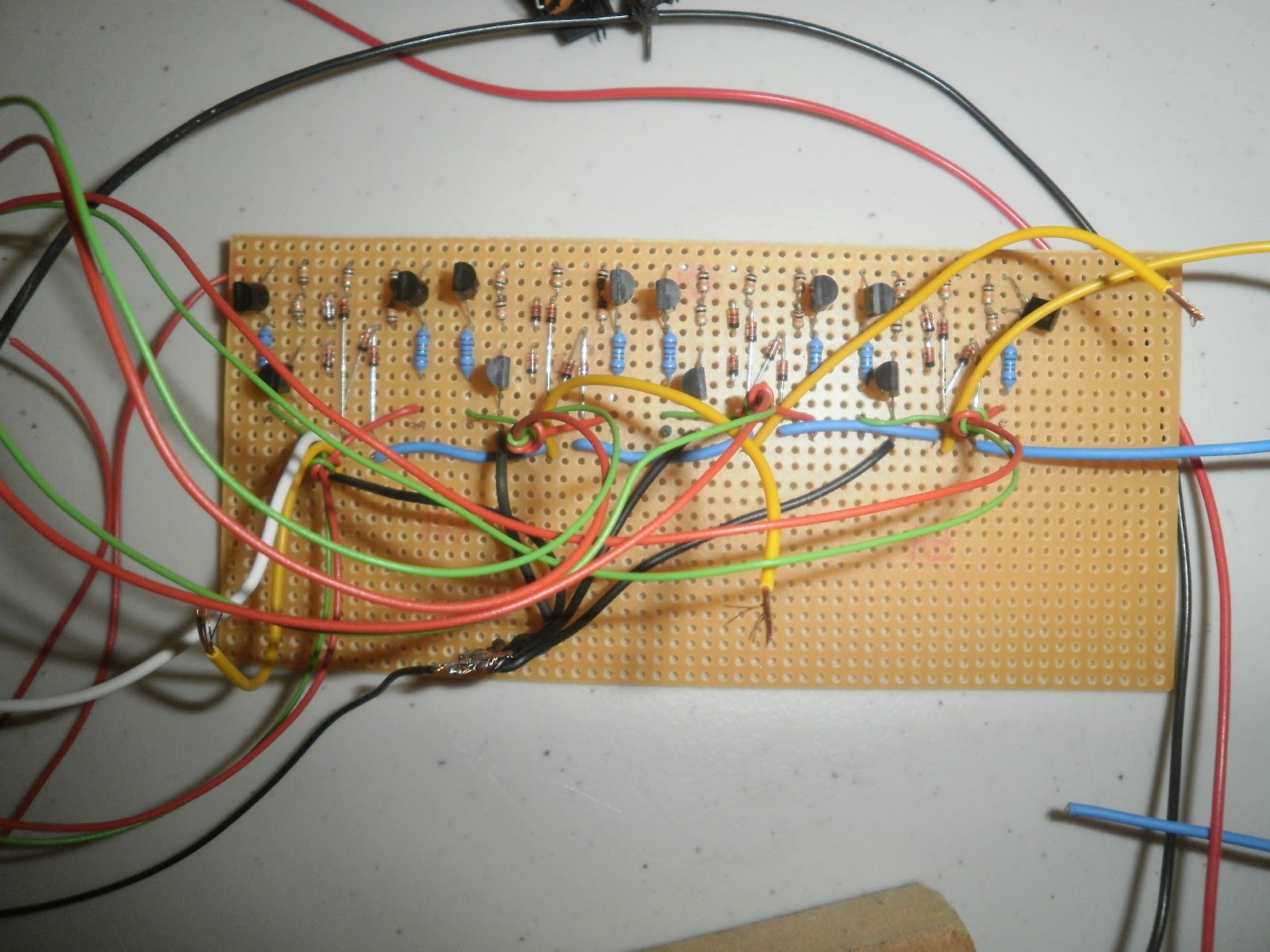
I got a scrap of 3mm MDF and I used miniature toggle switches to represent block occupancy detection and turnout position with common cathode red/green LED's to simulate signal heads. The test includes bi-directional movement over seven main line blocks, a passing siding and a branch line.
Rear view - the PCB in bottom left is a 12 volt 1 amp regulated power supply
My first breadboard attempt - It actually worked ok...
My first 8 module board.
I need to build two more 8 module boards so I have enough circuits to test the logic for bi-directional operation. Once I have established the diode matrix for all the inputs the "modelling" of the proof of concept will be complete - this should happen some time this year.
Thanks to the Monday Night crew and BJ for all their efforts.
This month's post is a few days late as I have been to Traralgon in Victoria for a week or so. Thanks Peter and Faye for a great week including: a day trip to Port Albert, great company, fantastic food and wines and of course many hours doing model train stuff. Before taking the Overland to Melbourne my crew did spend time working on the layout this month and we achieved a lot visually as well as that cannot be seen like wiring.
Hornertown
Lots of activity in Hornertown this month from wiring turnouts, painting sleepers, trial ballasting, roadways, city buildings and retaining walls.
Roadways
City Classics
Thee Cornerstone buildings have been slowly progressing towards the final installation some 18 months after the "first activity" see Barry "Building", Ross making the building "stand offs", BJ "air-brushing", my first (not so good) attempt at hand painting details, window treatments and the final installation.
Sorting out the order...
Applying the wall colours
My first attempt at hand painting
I guess I need more practice....
Looking better after I "touched up" the brickwork by hand.
BJ's "detail painting"
Just a bit better than mine - BTW he did not do any "touch ups" unlike me!
The end results....
BJ's "township" scene
BJ's artistic mind has been at work again so he has painted buildings on artist card and has added depth by placing building outlines over previous building work. The scene ended up over three metres long.
BJ's "air-brushing"
Now time to apply "years" of dust, dirt and smog effects on the town buildings...
Firstly to the Town Hall built by Bill 1....
The detailed City Classics....
Window treatments
These
were added to the rear face of the structure after the finishing
touches of "grot and grime" were applied by BJ with his airbrush.
Installing the City Area scene
Lots of different activities by a number of contributors leading to what I think is a great result.
Photos are from left (east) to right (west) along the township scene.
Installation of retaining wall below the "town"
Various textures from CG Textures website were downloaded, manipulated and printed to decide what suited the overall scene best.
We decided that to continue that of the retaining wall on the Eastern end of the town albeit 12mm higher. Using Microsoft Visio I added the additional section and the printing on card commenced and the installation can be seen below. Note that this time we have install a hard wood footing which was painted and the ground cover laid up to it so as to avoid the capillary action problem we encountered at Hornertown East.
Yard
BJ had been trialing two styles of painting and ballasting and we have decided on the style on the right hand side. BJ has calculated that about 300 hours of painting is required.Look out Barry must work awaits when you visit on a Monday night!
Main Yard Panel
Installation of the turnout wiring from the local panel to the turnouts has commenced.
Interlocking
The time has come to establish the interlocking of the turnouts from the mainline into the arrival departure tracks at Hornertown - the main yard. The principle is that when the main panel has control of the turnouts within the yard limits the local panel controls are isolated so the local operator cannot access the turnouts. The interlock will switch the capacitor discharge unit feeds between panels as they get their respective power from different transformers on the accessory power grid.. The point position indicators are required on both the local and mainline control panels.
The relay base connections....
Ready for addition of the relays.
Hornertown East Retaining Wall
Last month I mentioned the problem we had with capillary action...
The sections have been reprinted and re-applied to "cover" the problem.
Daveyston
BJ's "air-brushing"
Now time to apply "years" of dust, dirt and smog effects on the remainder of the town buildings...
Model Railcast Show Update
I had the pleasure of talking to Ryan Andersen and Craig Bisgeier over Skype to discuss what has been achieved by my team (since my previous interview Show #123) over the last 18 or so months (Show #161).
Trip to State of Victoria
The video below shows a few of the trains Peter proposes to run on his N scale layout. They were representative of what he has and were used for testing the mainline track work.
We discovered that relying on the Peco Insulfrog closure rails for power
connection to the frog rails was less than satisfactory so installation
of jumpers between the frog rails and the stock rails was undertaken.
Most turnouts were removed and jumpers installed underneath the rails
however a few had been fixed in place so above tie jumpers were
installed.
Since my last visit Peter has built a new test track with broader curves and the larger locos now run without binding due to the radius being too tight. Peter has Digitrax Zephyr on both the main layout and test track, he has a PR3 interface to interface his laptop. The test track serves as a programing track and the rotary switch is used to move between Service mode and Operations mode within DecoderPro. He has a Android with a "LapStar Talking Stopwatch" App for timing. We practiced using the spreadsheet I have developed for loco speed matching.
We tried the DecoderPro WiThrottle with Android "Engine Driver" App and it does work although Peter's WiFi network as somewhat busy with six or seven devices concurrently connected! We received timeout messages from the WiThrottle server.
Thanks again must go to my crew and Peter for the activities this month.